The difference between dermaplaning and shaving comes down to purpose and depth. Dermaplaning is a professional skin care treatment that uses a sterile single-use blade held at a 45-degree angle to remove dead skin cells and fine vellus hair from the face. Shaving uses a multi-blade consumer razor aimed only at hair removal. According to the Cleveland Clinic’s dermaplaning overview, dermaplaning shaves away the uppermost layers of skin, making it a true exfoliation method. Shaving does not exfoliate, so the two are not interchangeable.
For anyone in Duluth weighing whether a dermaplaning facial belongs in their skin care routine, the distinction matters more than it might seem. The right choice depends on what your skin actually needs, not just whether you want the hair gone.
What Is Dermaplaning, and How Does It Work?
Dermaplaning is a physical exfoliation treatment performed by a licensed esthetician using a sterile, single-use professional blade. Here is how it works, step by step:
- Blade angle: The blade is held at a 45-degree angle against taut, dry skin.
- Single controlled pass: The esthetician moves the blade in short, upward strokes to lift dead skin cells and vellus hair simultaneously.
- Dual result: One treatment delivers physical exfoliation and hair removal in a single pass, with no downtime.
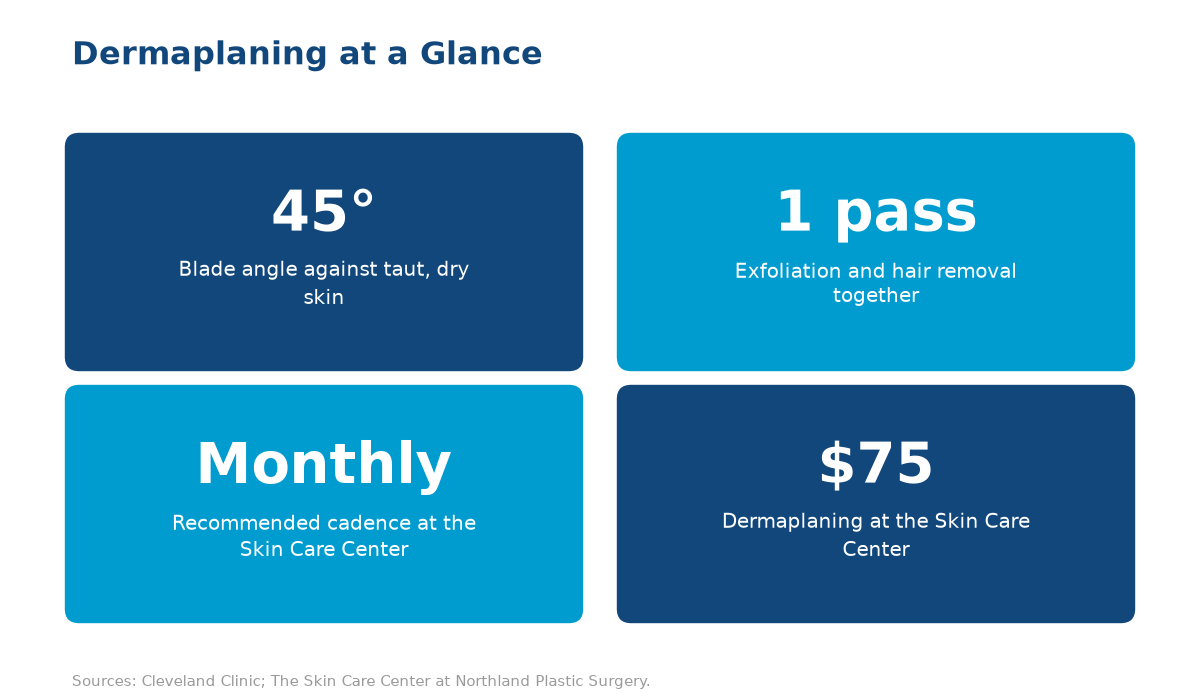
The Cleveland Clinic classifies dermaplaning as a minimally invasive cosmetic procedure. The version performed at the Skin Care Center at Northland Plastic Surgery is non-invasive and carries no recovery period. For full dermaplaning service and pricing details, including the $75 starting price and aftercare instructions, see the Center’s service page.
How Is Dermaplaning Different from Shaving? A Side-by-Side Comparison
The difference between dermaplaning and shaving is clearest when the two are placed side by side across five key attributes.
| Attribute | Shaving | Dermaplaning |
|---|---|---|
| Purpose | Hair removal only | Hair removal plus exfoliation of dead skin cells |
| Tool Used | Multi-blade consumer razor with safety guards | Sterile single-use professional blade |
| Blade Type | Multiple blades designed for safety and speed | One precision blade optimized for controlled skin contact |
| Depth of Action | Grazes the surface without touching skin layers | Lifts the uppermost layers of skin per Cleveland Clinic |
| Who Performs It | Self-administered at home | Licensed esthetician in a professional setting |
The tools, technique, and outcomes are different enough that dermaplaning and shaving should not be treated as substitutes for each other. One removes hair; the other also resurfaces the skin.
What Are the Benefits of a Dermaplaning Facial?
A dermaplaning facial delivers several results that a standard shave cannot replicate. Here is what clients typically notice:
- Instant brightening: Accumulated dead skin cells dull the complexion. Removing them in a single pass reveals fresher, more luminous skin underneath.
- Smoother texture: Vellus hair traps oil, makeup residue, and environmental debris on the skin’s surface. Clearing it leaves a noticeably cleaner, more even texture.
- Better product absorption: A cleared surface allows water-based serums to penetrate more effectively. This matters for the Center’s hydration-first approach: serums hydrate the skin first, and a moisturizer seals that hydration in. Dermaplaning makes that sequence work better.
- Flawless makeup application: Foundation sits on a flat, hair-free surface rather than catching on fine hairs, which means smoother, longer-lasting coverage.
- Softened fine lines: Smoothing the surface blurs the appearance of shallow lines without any injectable or surgical intervention.
Dermaplaning is not appropriate for everyone. The Cleveland Clinic lists active acne, cold sores, eczema, psoriasis, and raised growths as reasons to speak with a provider before scheduling. The Center’s own Therapeutic Facial page notes that the treatment is not recommended for clients with rosacea, eczema, or psoriasis.
Why Does Duluth’s Climate Make Professional Dermaplaning Worth Considering?
Duluth winters are long, cold, and dry. Indoor heating draws moisture from the air and from skin, and the wind off Lake Superior accelerates that loss. The cumulative effect on local skin is real and worth addressing with more than a basic moisturizer.
Guidance from the American Academy of Dermatology connects cold, dry air and indoor heating to a compromised skin barrier and accelerated moisture loss. When the barrier is already stressed, dead skin cell buildup tends to be heavier, making physical exfoliation more relevant, not less.
At-home shaving removes hair but leaves that buildup in place. Dermaplaning addresses both at once: it clears the accumulated dead cells and removes the vellus hair that traps debris, so the skin surface is prepared for hydration. After a session, water-based serums can reach skin more effectively, which matters especially during the months when Duluth’s climate is working against the skin barrier.
The Skin Care Center at Northland Plastic Surgery is located at 4316 Rice Lake Road in Duluth and serves clients dealing with exactly these seasonal conditions year-round.
How Often Should You Get Dermaplaning?
The Skin Care Center recommends a monthly cadence. The Center’s Therapeutic Facial page advises returning monthly to keep skin looking and feeling its best, and that interval aligns naturally with the skin’s own renewal cycle.
For most clients, a standing monthly appointment is the usual rhythm. That said, Duluth winters can shift what individual skin needs. Cold temperatures and indoor heating can stress the skin barrier in ways that affect timing, and the estheticians make that call in person after evaluating each client’s skin.
If you have sensitive or dry skin and want guidance specific to your skin type, the Center’s page on dermaplaning for sensitive and dry skin explains how the treatment performs for those concerns. A skin analysis with the Center’s estheticians sets the right interval for your individual skin.
Is Dermaplaning at a Skin Care Center Different from What You Can Do at Home?
Yes, and the difference goes beyond the tool itself. At-home dermaplaning devices are smaller, less rigid, and are not the sterile single-use professional blade an esthetician works with. The blade is only part of the equation.
Professional technique requires holding the blade at a precise 45-degree angle on taut skin throughout the entire treatment. An incorrect angle increases the risk of nicks and uneven exfoliation. A licensed esthetician also assesses contraindications before beginning, including active breakouts, eczema, and rosacea, so the treatment is only performed when it is appropriate for the client’s skin on that day.
The Skin Care Center’s estheticians, Ardie Besser and Michelle Sturm, are licensed advanced practice estheticians and skin care specialists. The practice has served Duluth since 1992. When you sit down with them, you are not getting a guided self-treatment; you are getting a professional assessment followed by a treatment matched to your skin’s current condition.
For clients who want more than a standalone dermaplaning session, the Therapeutic Facial starting with dermaplaning layers in medical-grade skin care products from NPS Superior Skincare, Obagi, ZO Skin Health, and Clinicians Complex for a deeper result than an at-home pass can deliver.
Schedule Your Dermaplaning Facial at The Skin Care Center of Northland Plastic Surgery in Duluth
If you have been relying on shaving or skipping exfoliation altogether, a professional dermaplaning facial may be the reset your skin needs, especially heading into or out of a Duluth winter. The Skin Care Center at Northland Plastic Surgery offers dermaplaning as a standalone treatment and as the foundation of its Therapeutic Facial, performed by experienced estheticians who assess your skin before every session.
Call to schedule your skin analysis at The Skin Care Center of Northland Plastic Surgery today: (218) 724-7363.