
How long does Latisse take to work? Full results take 8 to 16 weeks of consistent nightly use. According to the FDA-approved prescribing information on DailyMed, published by the National Library of Medicine, fifty percent of patients in a clinical study showed significant improvement at 2 months, and the pivotal trial measured full efficacy at 16 weeks. Consistent nightly application is the single most important factor: skipped nights slow progress, and lashes return to their pre-treatment baseline once use stops.
Does Latisse Really Work?
Yes, Latisse is clinically proven to grow eyelashes. Here is what the science says:
- FDA-approved for hypotrichosis: Latisse is the only FDA-approved prescription treatment for hypotrichosis, the clinical term for inadequate or sparse eyelashes.
- How it works at the follicle level: Its active ingredient, bimatoprost 0.03 percent, extends the anagen (active growth) phase of the hair follicle and increases the number of hairs that grow during each cycle.
- Documented milestones: The DailyMed label records significant improvement in lash length, thickness, and darkness at weeks 8, 12, and 16 in the pivotal clinical trial.
- Patience is part of the process: Results are real, but the follicle cycle itself dictates the pace, not the product’s potency.
For anyone wondering whether Latisse eyelash growth serum is worth the commitment, the short answer is yes, provided expectations are calibrated to the biology involved.
What Should You Expect Week by Week?
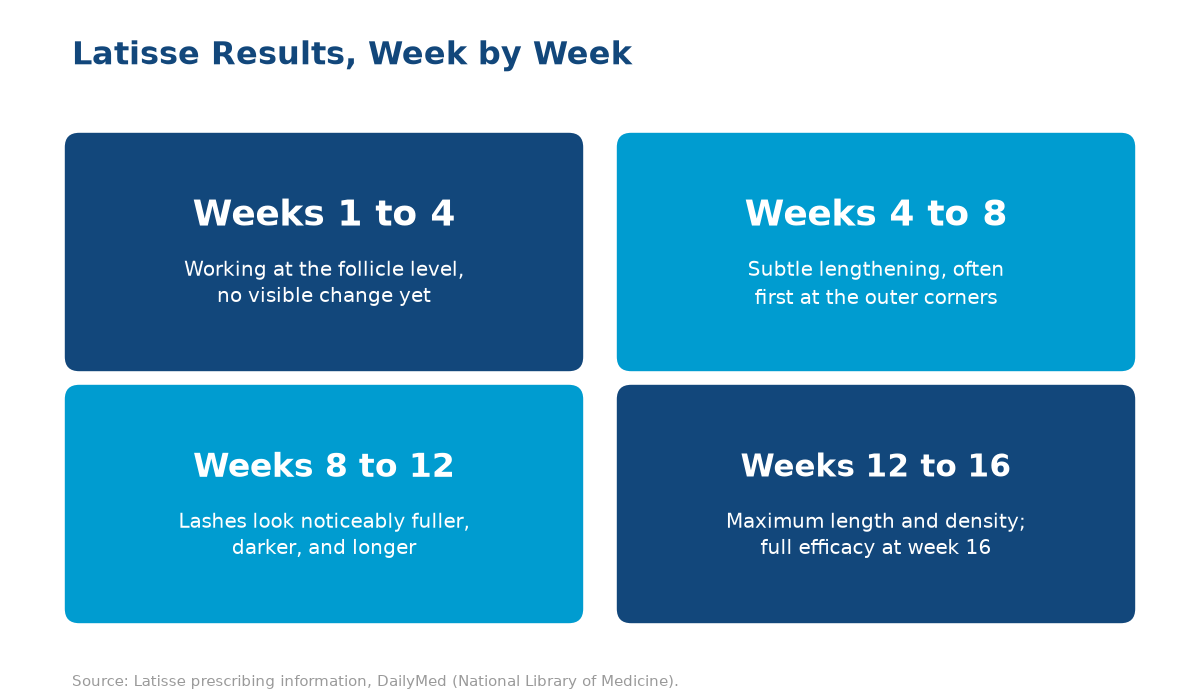
One of the most common questions about Latisse before and after is what changes to look for and when. The timeline below is grounded in the DailyMed prescribing information:
- Weeks 1 to 4: Bimatoprost is working at the follicle level. No visible changes are typical during this phase, which is the stage where most people give up too soon.
- Weeks 4 to 8: Subtle lengthening may appear, often first at the outer corners of the lash line.
- Weeks 8 to 12: Lashes look noticeably fuller, darker, and longer. This aligns with the 50 percent improvement milestone documented in the FDA label.
- Weeks 12 to 16: Maximum length and density develop. The DailyMed label marks week 16 as the endpoint for full efficacy measurement.
- After week 16: Maintenance use preserves results. Stopping treatment allows lashes to return to their pre-treatment baseline within weeks to months.
Understanding this timeline helps set realistic expectations for Latisse for eyelash growth and makes it easier to stay consistent through the early weeks when results are not yet visible.
How Do You Apply Latisse Correctly?
Proper application matters for both safety and results. Follow these steps every night:
- Wash your face completely and remove all eye makeup.
- Remove contact lenses. You may reinsert them after 15 minutes.
- Place one drop of Latisse onto the sterile, single-use applicator brush included in the kit.
- Draw the brush along the skin at the base of your upper lash line only, moving from inner to outer corner.
- Blot any excess solution outside the lash line with a clean tissue.
- Discard the applicator and use a fresh brush for the other eye to prevent cross-contamination.
Two additional rules apply regardless of where you are in the process:
- Apply once nightly only. Applying more often does not accelerate results and increases the risk of side effects.
- Never apply to the lower lash line directly. The lower lashes pick up residual solution through blinking, which is sufficient.
If you are unsure about your technique, our skin care specialists at The Skin Care Center of Northland Plastic Surgery can walk you through application when you pick up Latisse at the Skin Care Center. Because Latisse is an FDA-approved product, it is a prescription and requires a consultation before purchasing.
What Are the Side Effects of Latisse?
Latisse side effects are manageable for most users, but knowing what to watch for helps you use the product safely.
Common and reversible side effects (roughly 3 to 4 percent incidence per the DailyMed label)
- Eye pruritus (itching)
- Conjunctival hyperemia (redness of the eye)
- Skin hyperpigmentation at the application site, which typically fades after stopping use
- Hair growth in areas outside the lash line if the solution contacts surrounding skin
Rare but potentially permanent side effects
- Increased brown pigmentation of the iris. The DailyMed label notes this change is likely to be permanent.
- Periorbital fat loss, which can create a sunken appearance around the eye
Two practical notes for all users:
- Contact lens wearers should remove lenses before application and wait 15 minutes before reinserting.
- Anyone with a history of elevated eye pressure should consult a prescribing provider before starting Latisse.
Why Does Duluth’s Climate Make Lash and Skin Care Consistency So Important?
Duluth winters are long, dry, and cold. Indoor heating strips moisture from the air for months at a stretch, and the wind off Lake Superior accelerates surface dryness on every exposed area of skin and hair. For anyone using Latisse, that environment matters.
Dry, heated indoor air can increase eye irritation during the first weeks of use, when minor redness or itching is already a possible side effect. Keeping the skin around the eye well hydrated supports a more comfortable adjustment period. The American Academy of Dermatology notes that dry indoor air and harsh outdoor conditions both compromise the skin barrier, making consistent moisturizing and hydration especially important in cold climates.
Hydration is the foundation of skin health. Drinking adequate water and using water-based serums supports the skin barrier, including the delicate periorbital area where Latisse is applied. A consistent nightly routine is easier to maintain through a Duluth winter when it is built around your existing skin care steps rather than treated as a separate task. Pairing Latisse with services like therapeutic facials and dermaplaning can help keep the surrounding skin in good condition through the colder months.
The Skin Care Center of Northland Plastic Surgery at 4316 Rice Lake Road in Duluth carries Latisse and can help you build a complete skin care routine suited to northern Minnesota conditions. Browse our full skin care product lines to see everything available alongside Latisse.
What Happens If You Stop Using Latisse?
This is one of the most important things to understand before starting treatment. According to the FDA-approved DailyMed prescribing information, eyelash growth returns to its pre-treatment level when Latisse treatment is discontinued.
The return to baseline is gradual. It typically takes several weeks to months, not overnight. That means Latisse is a maintenance treatment, not a one-time correction: it works only as long as you use it. Planning for long-term use from the start, including budgeting for an ongoing supply, is part of realistic expectation-setting. Our skin care specialists at The Skin Care Center of Northland Plastic Surgery can walk you through what a sustainable Latisse routine looks like alongside your other skin care products.
Schedule a Consultation at The Skin Care Center of Northland Plastic Surgery in Duluth
If you are ready to see what Latisse for eyelash growth can do, The Skin Care Center of Northland Plastic Surgery is the place to start. Our experienced estheticians at 4316 Rice Lake Road, Suite 109, Duluth, MN 55811 carry Latisse and can help you determine whether it is the right fit for your lash goals and skin care routine. Call (218) 724-7363 to schedule your Latisse consultation at The Skin Care Center of Northland Plastic Surgery today!