
Yes, breast reconstruction is covered by insurance under most health plans in the United States. A federal law called the Women’s Health and Cancer Rights Act (WHCRA) of 1998 requires any group health plan that covers mastectomies to also cover all stages of breast reconstruction, surgery on the opposite breast for symmetry, external breast prostheses, and treatment of physical complications. That protection applies whether you have reconstruction at the time of your mastectomy or years afterward, so patients across the Arrowhead Region can generally expect their insurer to apply the same coverage standards to reconstruction that it applies to the mastectomy itself. If you have questions about your specific benefits, the team at Northland Plastic Surgery in Duluth is here to help you navigate the process.
Understanding exactly what your plan covers, and how to document your claim, can feel overwhelming during an already difficult time. This guide breaks down the federal protections, explains what to expect for different surgical methods, and outlines how Northland Plastic Surgery supports patients from consultation through recovery.
What Does the Women’s Health and Cancer Rights Act Require My Plan to Cover?
The WHCRA federal coverage requirements are broader than many patients realize. Any group health plan or insurance policy that covers mastectomy must also provide the following benefits:
- All stages of rebuilding the breast that was removed , whether reconstruction begins at the time of mastectomy or months or years later
- Surgery and adjustments on the other breast to create a symmetrical appearance, such as a lift or reduction on the unaffected side
- External breast forms (prostheses) worn before or instead of surgery
- Treatment of physical complications of mastectomy , including lymphedema, which is swelling caused by damage to the lymph nodes
- Follow-up and revision procedures required over time as the reconstructed breast settles or as your body changes
One important note: standard deductibles, copays, and coinsurance still apply. However, your insurer cannot charge a higher cost-sharing rate for reconstruction than it charges for other covered surgeries.
Does Insurance Cover Breast Reconstruction After a Lumpectomy?
A lumpectomy, or partial breast removal, leaves a tissue defect that breast reconstruction can correct. Most insurance plans treat this correction as medically necessary reconstruction, though the rules differ slightly from mastectomy coverage.
- The WHCRA’s explicit mandate applies to mastectomy, but most insurers and Minnesota-regulated plans extend equivalent coverage to partial reconstruction when a physician documents medical necessity.
- Your insurer uses a defined set of clinical criteria to determine whether a procedure qualifies; your surgeon can prepare and submit documentation to support your claim.
- Patients should confirm lumpectomy-related reconstruction benefits directly with their plan before scheduling surgery, since coverage language varies by policy.
If your insurer initially denies coverage for post-lumpectomy reconstruction, an appeal supported by your surgeon’s documentation often reverses that decision. The team at Northland Plastic Surgery can help coordinate the documentation your plan requires.
What Types of Breast Reconstruction Does Northland Plastic Surgery Offer?
Northland Plastic Surgery offers both implant-based and tissue-based approaches, and your surgeon will recommend the method that best fits your anatomy, cancer treatment plan, and personal goals. You can review the full range of reconstructive breast surgery services available at our practice.
Implant-Based Reconstruction
Implant-based reconstruction places a breast implant either at the time of mastectomy (immediate reconstruction) or in a staged procedure that begins with a tissue expander. The expander gradually stretches the skin over several weeks or months before a permanent implant is placed in a second surgery. This approach typically involves a shorter operating time and a faster initial recovery than flap procedures.
Tissue Flap Reconstruction
Tissue flap procedures use your own body tissue to rebuild the breast, which can produce a more natural feel and long-term result. Methods available at Northland Plastic Surgery include:
- DIEP flap: The deep inferior epigastric perforator flap uses skin and fat from the lower abdomen while preserving the abdominal muscle, which reduces donor-site recovery compared to the TRAM flap.
- TRAM flap: Tissue, including skin, fat, and muscle, is taken from the abdomen and moved to the chest to form the new breast.
- Latissimus dorsi flap: Tissue from the upper back is used to reconstruct the breast, often combined with an implant for additional volume.
Learn more about specific breast reconstruction options at Northland to understand which approach may be right for you.
How Long Does Breast Reconstruction Surgery Take?
Operating time varies significantly depending on the method chosen and whether reconstruction is performed at the same time as the mastectomy. The National Cancer Institute breast reconstruction describes the range of approaches and their general recovery timelines.
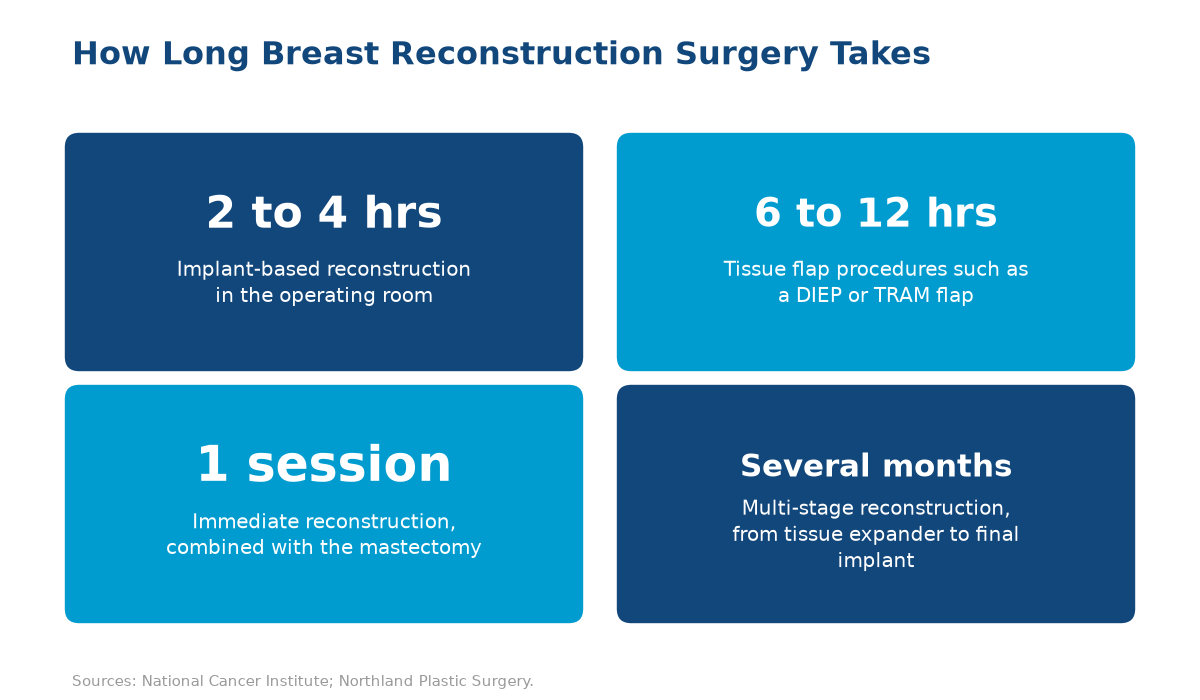
- Implant-based reconstruction: Approximately 2 to 4 hours in the operating room.
- Tissue flap procedures such as a DIEP or TRAM flap: Approximately 6 to 12 hours, given the complexity of moving and shaping donor tissue.
- Immediate reconstruction (performed during the mastectomy): Total operating time is longer because both procedures are combined in a single session.
- Multi-stage reconstruction: Tissue expansion followed by a second surgery to place a permanent implant spans several months from the first procedure to the final result.
Your surgeon will give you a realistic timeline based on the specific method selected, your overall health, and whether radiation therapy is part of your treatment plan. Radiation can affect the timing and choice of reconstruction, and your care team will account for that.
Does Medicare or Medicaid Cover Breast Reconstruction?
Federal and state programs both provide meaningful coverage for qualifying patients.
- Medicare: Federal Medicare plans are required by the WHCRA to cover breast reconstruction following a mastectomy under the same terms as the mastectomy itself. Cost-sharing such as deductibles and coinsurance still applies.
- Medicaid: Minnesota’s Medicaid program, called Medical Assistance, covers breast reconstruction when it is determined medically necessary. Patients should verify their current coverage details with the Minnesota Department of Human Services, as specific benefit structures can change.
- Out-of-pocket costs: Reconstructive services at Northland Plastic Surgery are billed directly to the patient’s insurance plan. The practice can assist patients in arranging financing for deductibles and coinsurance through available payment plans.
If you are unsure whether your Medicare or Medicaid plan covers a specific reconstruction method, call Northland Plastic Surgery and our team can help you ask the right questions before your consultation.
Call to Schedule Your Breast Reconstruction Consultation in Duluth and the Arrowhead Region
Northland Plastic Surgery has served patients in Duluth and across northeastern Minnesota’s Arrowhead Region since 1992. The practice is located at 4316 Rice Lake Road, Suite 109, Duluth, MN 55811. Our experienced surgeons offer implant-based and flap reconstruction, including TRAM, DIEP, and latissimus dorsi procedures, and can work with you from the initial consultation through every stage of your recovery.
Reconstructive consultations and procedures are billed to your insurance plan. Call (218) 724-7363 to schedule your consultation and take the first step toward understanding your reconstruction options.